POSTS
Lack of News Coverage on Andrew Yang Reflects Racial Biases in Media
Author: Lena Han
Punditry about Andrew Yang’s presidential campaign is conspicuously missing.
Although he began his campaign with no political experience or name recognition, Yang successfully qualified for the September Democratic primary debates earlier than several other major candidates. Today, he is consistently polling around eighth place, but his media coverage remains disproportionately low. According to RealClearPolitics, Yang is ranked 13th in terms of TV media coverage and a dismal 19th in terms of online mentions. Both mainstream broadcast and print journalism seem to have written him off as a blip in the crowded primary field.
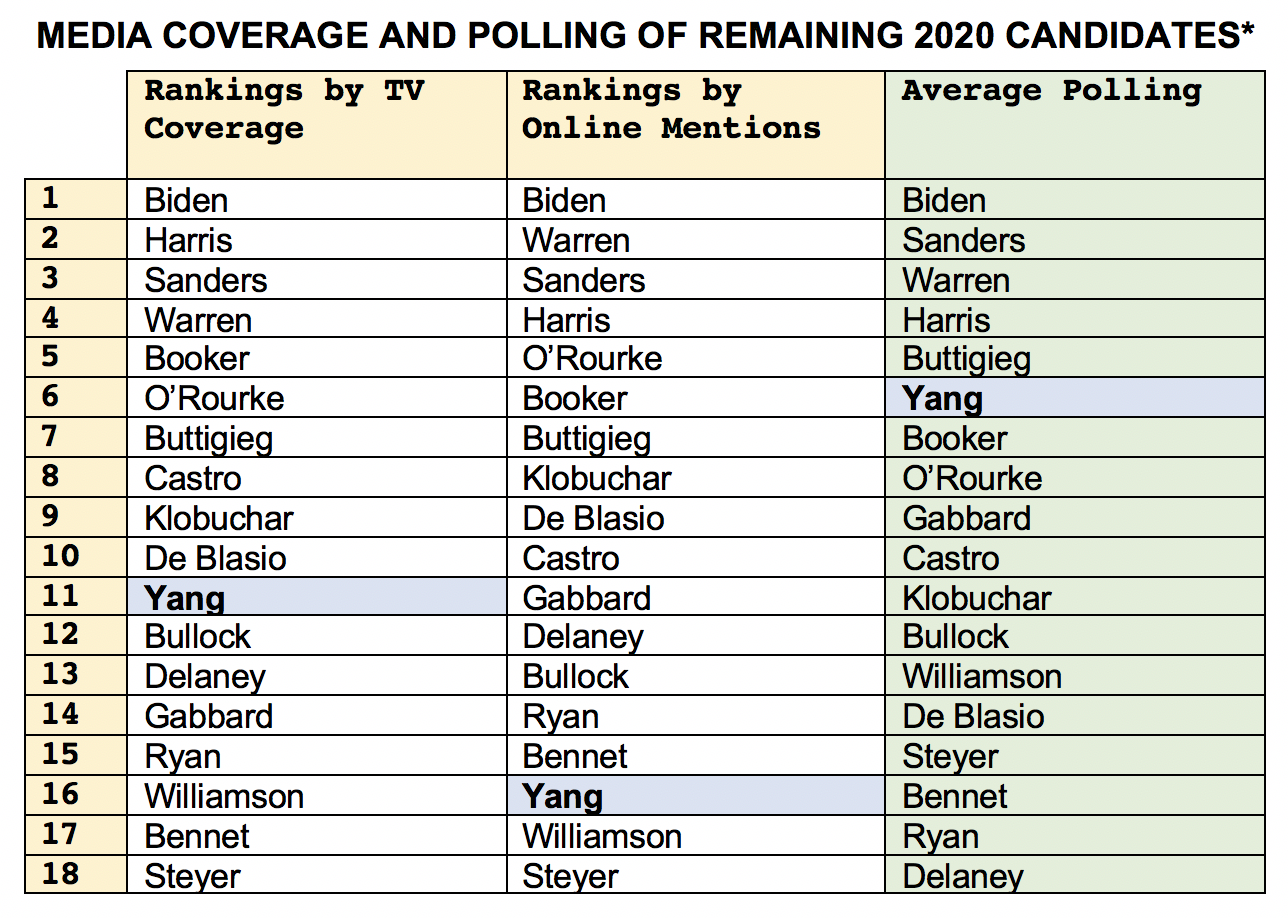 * RealClearPolitics included candidates who have since withdrawn from the race
This is, at least partially, a product of racial biases and lack of Asian representation in newsrooms. Despite constituting 6 percent of the country’s overall population, Asian Americans make up only 4.2% of the overall newsroom workforce and 3% of the newsroom leadership, according a 2016 survey by the American Society of News Editors. This dismal representation, coupled with long-standing stereotypes, results in an under-discussed Yang campaign.
I am never one to place the blame on race lightly. Certainly, many arguments can be made about why the Yang campaign has flown so far under the radar. But given his growing success in both polls and fundraising, the media’s dismissal of his campaign has become increasingly difficult to justify in terms outside of race.
For instance, I am sensitive to the media’s preference of covering more traditionally-credentialed candidates because they have may a better chance of winning. However, any claim that Yang’s chances are lower than those of candidates such as Bill de Blasio, who has never polled above 1%, are dubious at best. Yang is not providing the media a shortage of content, either. From his trademark Freedom Dividend proposal to his unfiltered Tweets (after registering 4% in a Colorado poll, he Tweeted, “Must be the weed :D”), Yang is no boring candidate. Furthermore, Yang’s focus on investing in cutting-edge technology brings a unique perspective into the primary.
Some may argue that the visibility of Kamala Harris, who is half Indian, proves that Yang’s failure to breach mainstream media is not rooted in race. I do not want to label one candidate as “more Asian” than another, but no candidate has leaned into their Asian identity the way Yang has, referring to himself as an “Asian man who likes math.” Yang describes his campaign fondly as “the nerdiest presidential campaign in history” and refreshingly embraces stereotypes that many Asian Americans avoid.
The media has never seemed to know what to make of Asian Americans, a minority group, but not a minority sharing the same struggles as black or Latinx populations. At times, Asian Americans are lumped in with white Americans in discussions about privilege; at other times, Asians are lumped in with other minority groups in discussions about representation in popular culture. In media, Asians are often regarded as an invisible monolith.
More crushing, though, are the pervasive stereotypes of Asians as quiet and submissive. These stereotypes have created barriers for Asian Americans from reaching management positions, as East Asians in particular have been labeled as the ideal subordinate employee. Within these perceptions, an Asian man running for the country’s highest office itself becomes a contradiction.
Certainly, Yang is still a long shot for the presidency. But for me, a Chinese American who has grown up accepting that my representatives will never look like me, Yang’s presence on a presidential debate stage is deeply meaningful. I can only hope that mainstream media takes a closer look at this unabashedly Asian American candidate.